
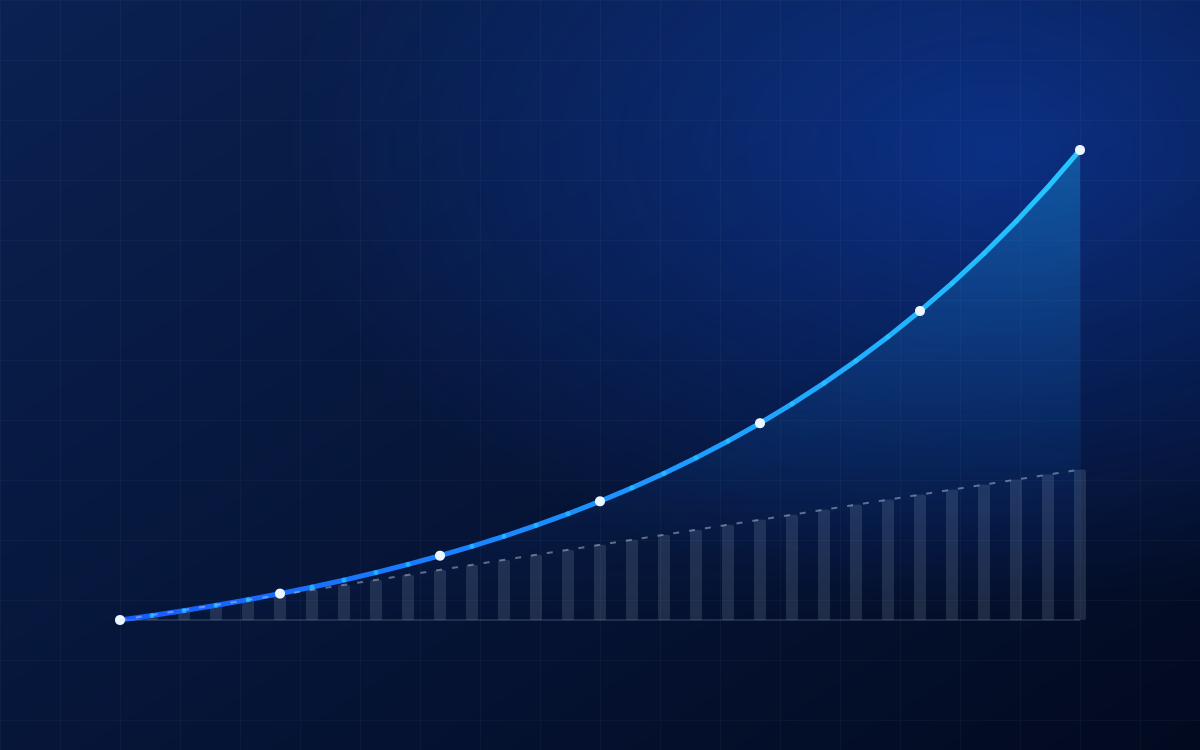
An illustration based on assumptions — not a forecast or a guarantee. Starting capital is invested immediately; monthly contributions are added at the end of each month. Returns are added monthly at the rate equivalent to the assumed annual return. Taxes, costs and inflation are not included. Nothing is stored or sent.
| Year | Total contributions | Hypothetical value | Growth / loss |
|---|
How the calculator works
A calculation is only as good as its assumptions. These are the starting points, with two examples you can check yourself.
Starting capital is invested right at the start. Monthly contributions are added at the end of each month, so a month’s contribution starts earning a return from the following month.
The annual return you enter is converted into an equivalent monthly return: (1 + annual return)1/12 − 1. Each month the value grows by that percentage. Over twelve months this comes to exactly the annual return you entered.
Taxes, fund and broker costs, and inflation are not included. The calculator also assumes the same return every year, while real returns fluctuate and can be negative.
Yes. Enter a negative return (down to −10% a year). The chart then shows, year by year, how much of your contributions has been lost, hatched in red. With a 0% return, the final value equals your total contributions.
€10,000 starting capital, no monthly contributions, 7% a year, 10 years: 10,000 × 1.0710 = €19,671.51.
€0 starting capital, €100 a month, 0% return, 10 years: 120 × €100 = €12,000.
No. The calculation runs in your browser. FortuneFlow doesn’t store your inputs or send them anywhere.
Keep reading
InvestingPreview
Earning a return on earlier returns sounds simple, but the effect only becomes visible over long periods.

InvestingPreview
Transaction fees, ongoing charges and spreads: small percentages that can add up over long periods.

WealthPreview
Certainty versus growth potential. How to weigh the choice against your goal, your time horizon and your buffer.